


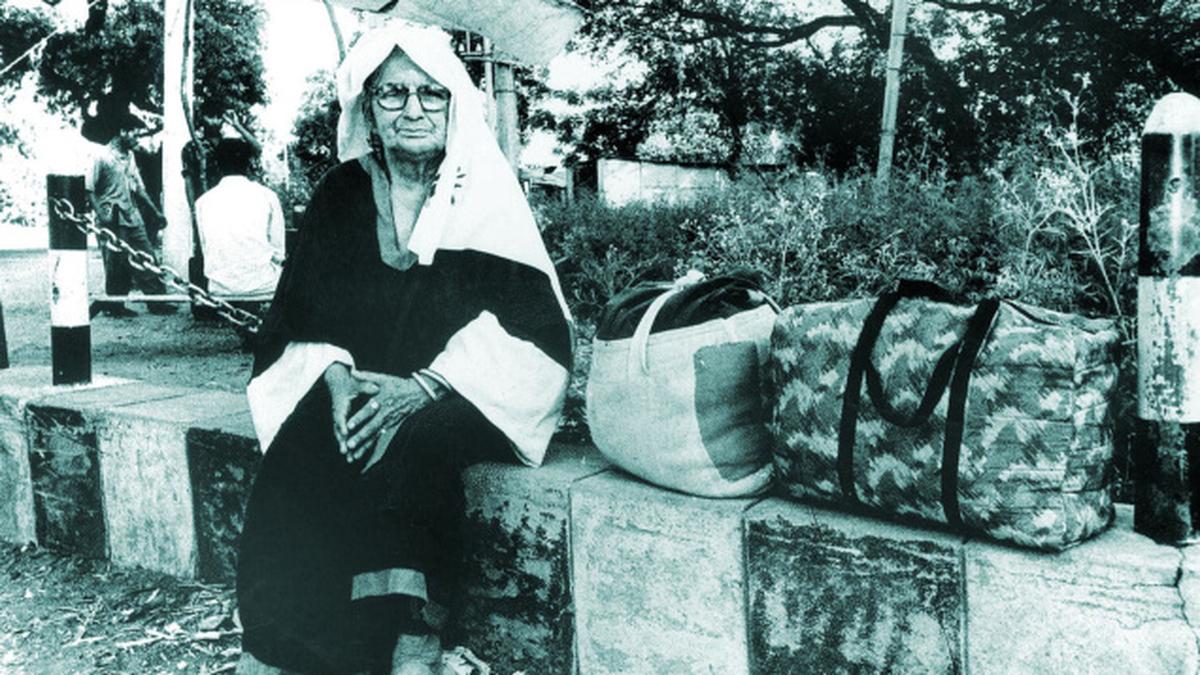
Kashmir Valley, 1989-90
It was from a neighbour that we heard the first rumours. He had gone to the ration shop to get sugar when he overheard a man exclaiming — ‘Inshallah, next ration we will buy in Islamabad!’ It was around this time that bus conductors in Lal Chowk could be heard shouting — Sopore, Hand’wor, Upore . Sopore and Handwara were border towns while Upore means across. Across the Line of Control. It was meant as an enticement for the youth to cross over the border for arms training, to launch a jihad against India.
On a hill in the Badami Bagh cantonment, someone had painted ‘JKLF’. One could see it from a distance. It stood for Jammu and Kashmir Liberation Front. It was rumoured to be an organization of young men who had crossed over the border to receive arms training.
At school we heard the word ‘mujahid’ for the first time. We knew this word. We had heard it on TV, accompanied by images of men in Afghanistan firing rockets from their shoulders. But in the context of Kashmir, it seemed out of place. What were mujahids to do in Kashmir?
On June 23, 1989, pamphlets were distributed in Srinagar. It was an ultimatum to Muslim women, by an organization that called itself Hazb-i-Islami, to comply with ‘Islamic’ standards within two days or face ‘action’. Pandit women were asked to put a tilak on their foreheads for identification.
On September 2, the 300-year-old Baba Reshi shrine was gutted in a fire under mysterious circumstances. On the same morning, a wireless operator of the Central Reserve Police Force (CRPF), was shot in our neighbourhood.
On the afternoon of September 14, I was playing cricket in the school grounds. My side won the match, and I was about to treat myself to an orange lolly with my pocket money when I felt someone’s hand on my shoulder. I turned back and saw Father standing there. He smiled.
‘Go and get your bag, we have to go home,’ he said. I thought something terrible had happened at home. ‘Why, what happened?’ I asked.
‘Someone has been shot in Habba Kadal. The situation will turn worse. So we need to head home.’
That was when the first Pandit fell to bullets. Some armed men had entered the house of the political activist Tika Lal Taploo and shot him dead.
The next day, Father did not let me go to school. We were told that Taploo’s funeral procession was pelted with stones. But barring that, nothing more untoward happened immediately after his death. I went back to school two days later. During the Hindi class, when the Muslim boys would be away for Urdu class, the Pandit teacher got an opportunity to discuss the killing with us. ‘Times are beginning to get tough,’ she said. ‘That is why it is important for all of you to study with renewed vigour.’ In its preliminary investigation, the state police believed that Taploo’s killing did not fit the pattern emerging from the activities of Kashmiri militants.
Twelve days after Taploo’s death, the then chief minister, Farooq Abdullah, performed a small piece of classical dance along with dancer Yamini Krishnamurthy during a cultural function at the Martand temple. A few days later, he assured people that militancy would end soon.
On Eid-e-Milad-un-Nabi, on October 14, a massive crowd gathered near the Budshah chowk in the heart of Srinagar, and from there, it marched towards Eidgah to the graveyard that had been renamed the ‘martyr’s graveyard’. The onlookers cheered and showered shireen on the marchers as if to welcome a marriage procession. That evening, father returned home with a neighbour and they told us they had witnessed the procession. The crowd was shouting slogans that had shocked them.
Yahan kya chalega, Nizam-e-Mustafa
La sharqiya la garbiya, Islamia Islamia
What will work here? The rule of Mustafa
No eastern, no western, only Islamic, only Islamic
Zalzala aaya hai kufr ke maidaan mein,
Lo mujahid aa gaye maidaan mein
An earthquake has occurred in the realm of the infidels,
The mujahids have come out to fight
It was indeed an earthquake. It toppled everything in Kashmir in the next few weeks. Within a few days the whole scenario changed. There was another series of bomb blasts outside other symbols of ‘Indianness’ — India Coffee House, Punjab National Bank, the Press Trust of India. Then the tide turned against wine shops and cinema halls.
It was only much later that we were able to connect this turmoil to world events occurring around the same time. The Russians had withdrawn from Afghanistan nine years after they swept into the country. In Iran, Ayatollah Khomeini had urged Muslims to kill the author of The Satanic Verses . In Israel, a Palestinian bomber struck in a bus for the first time, killing sixteen civilians. A revolution was surging across Eastern Europe; and a bloodied frenzy was about to be unleashed against the Armenian Christian community in Azerbaijan.
In the midst of this chaos, my eldest uncle came from my father’s village to visit us. ‘The water in the spring at the goddess’s sanctum has turned black,’ he whispered. This was considered to be ominous. Legend had it that whenever any catastrophe befell our community, the spring waters turned black.
That it was indeed a catastrophe became clear on the night of January 19, 1990.
Jammu, post-exile, early 90s
Some of our erstwhile neighbours had realized that we were in an acute financial crisis and that this was the right time to buy our properties at a fraction of what they were really worth. The houses of Pandits who had lived in posh colonies were much in demand. Many in Kashmir wanted to shift their relatives, who stayed in villages or congested parts of the city, to better houses, to better lives. You would be sitting in your home when a man would suddenly arrive at your doorstep. ‘Asalam Walekum,’ he would greet you while removing his shoes at your doorstep. Once inside, he would embrace you tightly. He would not come empty-handed. He always carried symbols of our past lives with him — a bunch of lotus stems, or a carton of apples, or a packet of saffron. He sat cross-legged beside you, running his eyes over the room — over the kitchen created by making a boundary of bricks and empty canisters, over the calendar depicting your saints, over your clothes hanging from a peg on the wall, and over to your son, sweating profusely in one corner and studying from a Resnick and Halliday’s physics textbook. He would nod sympathetically, accepting a cup of kahwa, and begin his litany of woes. ‘You people are lucky,’ he would say. ‘You live in such poor conditions, but at least you can breathe freely. We have been destroyed by this Azadi brigade, by these imbeciles who Pakistan — may it burn in the worst fires of hell! — gave guns to. We cannot even say anything against them there, because if we do, we will be shot outside our homes. Or somebody will throw a hand grenade at us.’ He would then sigh and a silence would descend upon the room, broken only by his slurps.
‘Accha, tell me, how is Janki Nath? What is his son doing?
Engineering! Oh, Allah bless him!’ He would patiently finish his kahwa while you sat wondering what had brought him to your doorstep. It was then that he came to the point.
‘Pandit ji,’ he would begin. ‘You must be wondering why I am here. I remember the good old days when we lived together. Whatever education we have, it is thanks to the scholarship of your community. Tuhund’ie paezaar mal chhu — it is nothing but the dirt of your slippers. Anyway . . .’ He would pause again.
‘I pray to Allah that before I close my eyes, I may see you back in Srinagar. But right now, it is so difficult. Tell me, what is your son doing? Oh, it’s his most crucial board exam this year!
Pandit ji, do you have enough money to send him to study engineering, like Janki Nath’s son? I can see that you don’t have it. This is why I am here.’
And then he would ask the crucial question: Tohi’e ma chhu kharchawun ? Do you wish to spend?
This was a well-thought-of euphemism he had invented to relieve you of the feeling of parting with your home. ‘Do you wish to spend?’ meant ‘Do you want to sell your home?’
‘You have had no source of income for months now,’ he would continue. ‘This is all I can offer you for your house. I know it is worth much more, but these are difficult times even for us.’
If you relented, he would pull out a wad of cash.
‘Here, take this advance. Oh no, what are you saying? Receipt?
You should have hit me with your shoe instead. No receipt is required. I will come later to get the papers signed.’
He would also forcibly leave a hundred-rupee note in your son’s hands and leave. A few days later, a neighbour would come around and ask ‘Oh, Jan Mohammed was here as well?’
‘His son has become the divisional commander of Hizbul Mujahideen,’ the neighbour would inform you.
Most of us did not have a choice. By 1992, the locks of most Pandit houses had been broken. Many houses were burnt down.
In Barbarshah in old Srinagar, they say, Nand Lal’s house smouldered for six weeks. It was made entirely of deodar wood.
The owner of Dr. Shivji’s X-ray clinic, Kashmir’s first, was told his house in Nawab Bazaar took fifteen days to burn down completely. At places where Pandit houses could not be burnt down due to their proximity to Muslim houses, a novel method was employed to damage the house. A few men would slip into a Pandit house and cut down the wooden beam supporting the tin roof. As a result, it would cave in during the next snowfall. Then the tin sheets would be sold and so would the costly wood. Within a few months, the house would be destroyed.
A few weeks after my parents’ trip to Ludhiana, my uncle came to our room, accompanied by a middleman. ‘He is offering to buy our house,’ Uncle said.
He put a number in front of us. ‘This is ridiculously low,’
Father said. ‘This is much less than what I have spent on it in the last few years alone.’
‘I know,’ the man said. ‘But you have no idea what has become of your house. After you left, miscreants ransacked it completely. They took away even your sanitary fittings and water ran through your house for months. A few walls have already collapsed. It is in a very poor state now.’
Nobody said a word. From her bed, Ma finally spoke.
‘How does it look from outside?’
‘The plaster has broken off completely, but your evergreens are growing well. They are touching your first-floor balcony now.’
And so, home is lost to us permanently.
(Rahul Pandita is Associate Editor, Open magazine. His book Our Moon Has Blood Clots is published by Vintage, Random House India.)

